Relief for Body is reader-supported. When you buy through links on our site, we may earn an affiliate commission. This doesn't affect our verdicts.
Short answer: The NHS page on back pain does not mention acupressure or spike mats at all, so treat one as a comfort and relaxation tool, not a treatment. If you want to try one, the ProsourceFit set is the proven seller on Amazon, and a larger 28.7-inch set with a carry bag is the one alternative worth a look. That is the whole shortlist: the other ProsourceFit results are color options of the same mat.
This is a gear page, not medical advice. If back pain is not improving after a few weeks, or any warning sign in the NHS list below applies to you, see a GP or a physiotherapist instead of buying equipment.
A spike mat is a small purchase that gets sold with big promises, so it is worth being plain about where it sits. Most back pain eases on its own, and the things that help most are boring ones: staying active, stretching and a heat or ice pack. Our pages on lower back stretches and natural remedies for lower back pain cover those. A mat can sit next to them as something to lie on at the end of a long day.
What the NHS says about back pain
The NHS page on back pain opens by saying that “Back pain, particularly lower back pain, is very common.” It adds that it “usually improves within a few weeks but can sometimes last longer or keep coming back”. On causes, it says “It’s not always obvious what causes it, and it often gets better on its own”, and that a common cause is “an injury like a pulled muscle ( strain )”.
The self-care advice is short. Under what to do, the NHS lists:
- “stay active and try to continue with your daily activities”
- “use an ice pack (or bag of frozen peas) wrapped in a tea towel to reduce pain and swelling”
- “use a heat pack (or hot water bottle) wrapped in a tea towel to relieve joint stiffness or muscle spasms”
- “try doing some exercises and stretches for back pain”
Under what not to do, it says “do not stay in bed for long periods of time”. It also notes that “Activities like walking, swimming, yoga and pilates may also help ease back pain.”
Acupressure mats, spike mats and similar devices do not appear anywhere on the page, either as a recommendation or as something to avoid. Nothing here should be read as the NHS endorsing the products below.
It also lists reasons to see a GP, including when back pain “does not improve after treating it at home for a few weeks” or “it’s stopping you doing your day-to-day activities”. One item is relevant to this kind of product, because a mat lies along the whole spine: the page says to get checked if the pain is “coming from the top of your back (between your shoulders), rather than your lower back”. Our guide to back pain red flags goes through the urgent and routine signs in more detail.
What a spike mat is, and what the evidence looks like
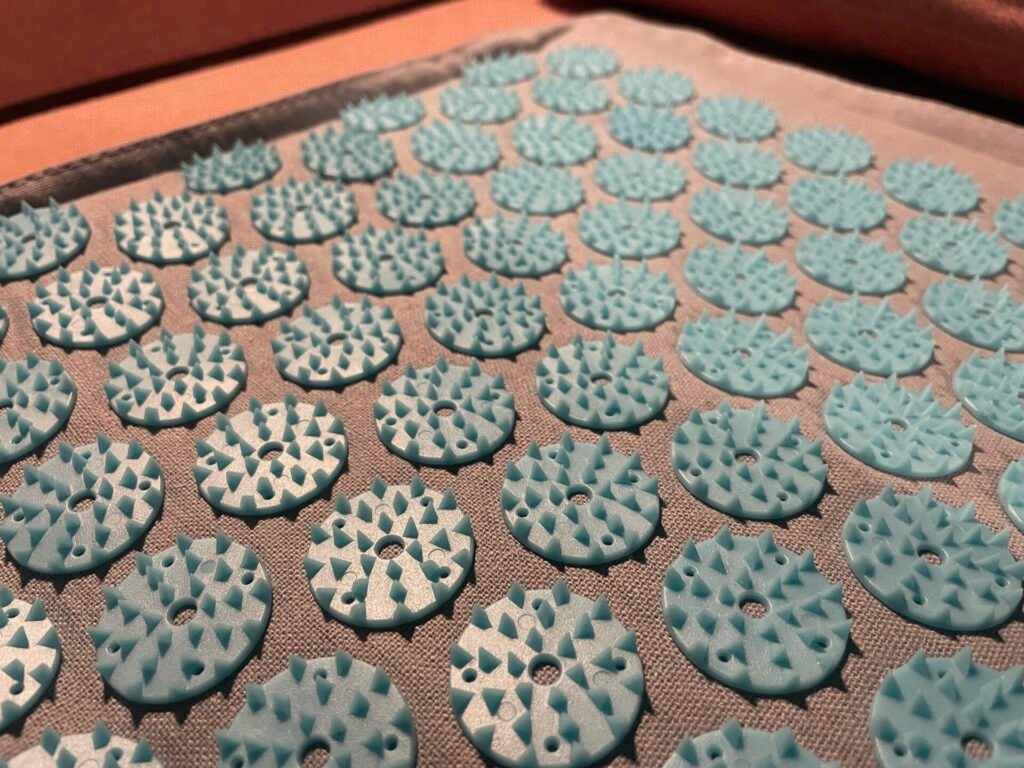
An acupressure mat is a foam pad covered in rows of small plastic points, usually sold with a matching pillow for the neck. You lie on it, and the points press into the skin through a thin layer of clothing. Both listings below say the points do not puncture the skin.
The sellers describe benefits such as muscle relaxation, better recovery after workouts and relief from back and neck tension. Those are marketing claims from the listings, and I have not found NHS text that supports or contradicts them. I have not tested these products, and I am not going to claim that lying on spikes treats back pain. What can be said honestly is narrower. Lying down still for 10 to 30 minutes is relaxing for many people, a firm textured surface gives a strong sensation that can distract from a dull ache, and the cost is low. If it helps you unwind, that is a fair reason to own one. If you are hoping it will cure a stubborn back problem, the NHS route of staying active and getting reviewed by a GP or physio is the one with guidance behind it.
Two acupressure mat sets compared
Amazon returns several results that look like different products. Four of them are the same ProsourceFit set in different colors or sizes: black, purple, pink and black with aqua, all showing the same rating, the same review count and the same price. I have grouped them as one product and picked a single listing. That leaves two distinct products, and I would rather give you two honest options than pad the list with duplicates.
| Product | What is in the box | Points | Key features from the listing |
|---|---|---|---|
| ProsourceFit Acupressure Mat and Pillow Set | Foam mat and foam neck pillow | 8,910 acupressure points between mat and pillow | Cotton cover, foam core, ABS plastic spikes; several colors |
| 28.7-inch Acupressure Mat and Pillow Set | Mat, pillow and carry bag | 6,930 on the mat, 1,782 on the pillow | Mat 28.7 x 16.5 in, pillow 15.3 x 5.9 x 3.9 in; plastic needles, high elastic foam |
Specs come from the Amazon listing bullets read in November 2026. Ratings and prices change often; check the listing before you buy.
ProsourceFit Acupressure Mat and Pillow Set (Black)
The best-known option by a wide margin, and the safe default for a first try.
- Rated 4.2 out of 5 from about 52,500 ratings; around $29.99 when checked.
- The listing states 8,910 acupressure points across the mat and pillow.
- Cotton cover, foam interior and ABS plastic spikes, per the listing.
- Sold in black, purple, pink and black with aqua, plus a Large version in some colors.
The seller suggests lying on it for 10 to 30 minutes, and warns that first-time users may find the feeling intense. A thin shirt between you and the spikes is the usual way to ease in. The pillow supports the neck, and the listing says the mat can also be used under the feet. The Large versions have their own listings, so read the dimensions on the page for the color you want before ordering, because the size is not the same across all of them. It has far more feedback behind it than the alternative.
28.7-Inch Acupressure Mat and Pillow Set with Carry Bag
A bigger mat for taller people, and cheaper, but with a much smaller review base.
- Rated 4.3 out of 5 from about 3,800 ratings; around $27.99 when checked.
- Mat is 28.7 by 16.5 inches, with 6,930 needles in 210 rounded tips.
- Pillow is 15.3 by 5.9 by 3.9 inches, with 1,782 needles in 54 tips.
- Comes with a carry bag.
The listing says this set was made larger because smaller mats are awkward for tall users, which is a fair point if your shoulders hang off the edge of a short pad. The listing is also the one that goes furthest on health claims, including talk of toxins and blood circulation, and I would not rely on any of that. Treat it as a mat that is bigger than some, and judge it on comfort. With roughly 3,800 ratings, it has a thinner track record than the ProsourceFit set.
Using one sensibly
Start with a few minutes, not half an hour. Wear a thin cotton shirt for the first sessions and lie down slowly, letting your weight settle rather than dropping onto the points. The sharp feeling fades in the first minute or two for many people. If it does not, or the sensation stays painful, get off the mat. The seller calls the first use intense, and that is not a goal to push through.
Keep your neck on the pillow and your back flat, and breathe slowly. Afterward, look at the skin. Pink dots that fade within a short time are common with this kind of mat. Broken skin, bruising or pain that lingers are reasons to stop.
Use it on top of the habits the NHS does list, not instead of them. A short walk, a few of the stretches on the NHS page, and a warm pack for stiffness will do more than any mat, and our heat versus cold therapy page explains when to reach for each. If you are mainly after a better evening wind-down, the sleep comfort products guide covers other low-cost options.
One practical point: skip the mat on any area that is bruised, swollen, injured or has a skin problem, and check with a pharmacist or GP if you are unsure whether it suits you.
Verdict
If you want to try a spike mat for relaxation after a long day, the ProsourceFit set is the sensible first buy, since it has the largest review base and comes in several colors. The 28.7-inch set is worth a look if you are tall or want a carry bag, with the caveat that far fewer people have rated it. Neither one has NHS backing as a back pain treatment, so keep moving, use heat or ice as the NHS suggests, and see a GP if the pain lingers for more than a few weeks.
Frequently asked questions
Does the NHS recommend acupressure mats for back pain?
No. The NHS back pain page does not mention them. Its self-care advice is to stay active, use ice or heat packs, try exercises and stretches, and avoid long periods in bed.
Is the pain relief on the listings proven?
The claims come from the sellers. I did not find NHS text that backs them, so it is safer to see a mat as a relaxation aid. If you notice it helps you unwind, that is a reasonable result on its own.
How long should I lie on it?
The ProsourceFit listing suggests 10 to 30 minutes. Many first-timers do better with a few minutes and build up, since the listing itself warns the sensation can be intense at first.
Do the different colors of the ProsourceFit mat differ?
On Amazon they show the same rating, review count and price, so they appear to be one product in different colors. Some listings are labeled Large, so check the stated dimensions of the version you pick.
Can I use one if my pain is between my shoulder blades?
The NHS says to see a GP if the pain is coming from the top of the back, between the shoulders, rather than the lower back. Get that checked first instead of trying a mat.
Should I use it instead of stretching or walking?
No. The NHS advice is to stay active and try stretches and exercises. A mat is something to do alongside that, not a replacement.
Sources
- NHS, Back pain.
- Amazon US product listings for the ProsourceFit acupressure mat and pillow set and the 28.7-inch acupressure mat and pillow set, bullets read in November 2026.
From the Relief for Body desk
Every guide here is built from the manufacturer’s own documentation, published safety guidance, and the pattern in what owners report over months of use, not from a lab or a clinic. Nothing is sponsored, and verdicts are settled before any affiliate link goes in. We are not clinicians, and nothing on this site replaces one. How we review explains the process.
This article is general information, not medical advice. If pain is sharp, persistent, or getting worse, see a clinician.
Google lets you pick which sites come up first in your own results.