Relief for Body is reader-supported. When you buy through links on our site, we may earn an affiliate commission. This doesn't affect our verdicts.
For people with chronic low back pain, the strongest evidence points to a medium-firm mattress rather than a very firm one. A randomized, double-blind trial of 313 adults found that those sleeping on a medium-firm mattress had less pain in bed and less disability after 90 days than those on a firm one. That is one trial, in one kind of back pain, and it does not turn “medium-firm” into a measurement you can read off a store label. Here is what it showed and where it stops.
The trial everyone cites
The study is Kovacs and colleagues, published in The Lancet in 2003 and indexed on PubMed. It was a randomized, double-blind, multicenter trial with 313 adults who had chronic non-specific low back pain, meaning no identified structural cause. Participants were assigned to either a firm mattress or a medium-firm one. The researchers rated firmness on a scale where 1.0 is the firmest and 10.0 the softest: the firm mattresses scored 2.3 and the medium-firm ones 5.6. Pain and disability were assessed at baseline and at 90 days.
At 90 days, the medium-firm group did better on two outcomes. Pain in bed favored medium-firm with an odds ratio of 2.36 (confidence interval 1.13 to 4.93), and disability favored it with an odds ratio of 2.10 (1.24 to 3.56). Pain on rising was in the same direction, with an odds ratio of 1.93, but the confidence interval ran from 0.97 to 3.86, which includes 1. That means the study could not rule out chance for that outcome.
The authors concluded that a mattress of medium firmness improves pain and disability among patients with chronic non-specific low back pain.
What the trial does and does not tell you
Read narrowly, the result is a comparison of two specific mattresses on one scale. It does not say that medium-firm is the best possible choice, only that it outperformed a firm one in this group. The trial did not test soft mattresses, and the odds ratios describe the chance of improvement, not how large the improvement was in everyday terms.
It also involved people who already had chronic low back pain. If your back is fine and you are shopping for comfort, the study does not speak to you, and if your pain is acute rather than chronic, the sample was not built to answer your case. And because the ratings used one researcher scale, a “medium-firm” label from a retailer may not correspond to a 5.6 on that scale. Retail firmness labels are not standardized in any of the sources here.
A later review of 39 articles
A 2021 review in the Journal of Orthopaedics and Traumatology looked at the broader literature, covering 39 articles. Its conclusion matches the trial: a medium-firm mattress promotes comfort, sleep quality and spinal alignment. The authors are also frank about the weak spots. Results across studies differed, there was little standardization of volunteers, and the type of low back pain was often poorly determined.
That candor is the useful part. A review whose authors flag mixed results and loose inclusion is telling you the signal is real but not sharp. The consistent direction, medium-firm over very firm, is better supported than any exact number.
| Source | Finding | Limit |
|---|---|---|
| Kovacs et al., Lancet 2003 (313 adults) | Medium-firm beat firm for pain in bed and disability at 90 days | Chronic non-specific low back pain only; pain on rising not clearly different |
| 2021 review, 39 articles | Medium-firm promotes comfort, sleep quality and alignment | Differing results, loose volunteer standardization, unclear pain types |
| Harvard Health | Try different firmness levels before buying; no single prescribed firmness | General guidance, not a trial |
Practical steps at the store and at home
Harvard Health does not prescribe a firmness. In its article on sleep and mattresses, the advice is to try different firmness levels before you buy, and it notes that memory foam molds to pressure points. It also suggests considering a new mattress if yours is more than a decade old.
Put together, a sensible approach looks like this. Skip the extremes of very hard or very soft. Lie on the mattress in your usual sleeping position for a few minutes, not seconds, and notice if your lower back feels supported or sagging. Ask about a trial period or a return policy, since a showroom is a short test and the trial ran for 90 days. If a full replacement is not realistic, the post on mattress toppers for back support looks at a cheaper adjustment, and the sleep comfort products guide puts the options side by side.
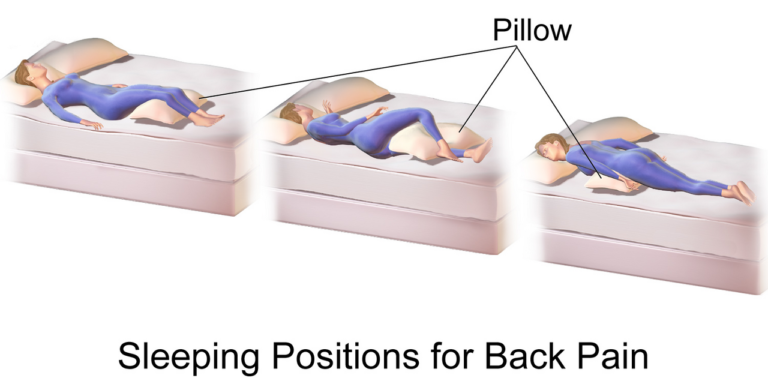
Keep in mind that a mattress is one input among several. Your sleeping position, pillow height and daytime activity all affect how your back feels in the morning. None of the sources here ranks them against each other.
When back pain deserves a visit instead of a new mattress
A new bed does not address pain that has a medical cause. The NHS says to see a GP if back pain has not improved after weeks of home treatment, stops you doing everyday activities, comes with unexplained weight loss, or does not improve after resting or is worse at night. NIAMS lists back pain after a fall or injury, and back pain with trouble urinating, leg weakness, fever or unintended weight loss, among its reasons to see a provider. Pain or numbness in both legs, or changes in bladder or bowel function, are emergency signs in the NHS guidance.
Our take
If you have chronic low back pain, a medium-firm mattress has the best trial support, and a 39-article review points the same direction while admitting mixed results. Do not read the label as a guarantee. Test the bed in your sleeping position, favor the middle of the range over the extremes, and see a clinician if the pain has warning signs or does not improve.
Common questions about mattress firmness and back pain
Is a firm mattress better for a bad back?
In the 313-person trial, a medium-firm mattress outperformed a firm one on pain in bed and disability at 90 days. The common belief that harder is better was not supported there.
How firm is medium-firm?
In the trial, medium-firm mattresses averaged 5.6 on a scale where 1.0 is firmest and 10.0 is softest, and firm ones averaged 2.3. Store labels are not standardized against that scale, so try the bed in person.
How old is too old for a mattress?
Harvard Health suggests considering a new mattress if yours is more than a decade old. It gives no firm cutoff beyond that.
Will a new mattress cure my back pain?
No source here promises that. The trial found improvement in pain and disability on a medium-firm mattress for people with chronic non-specific low back pain, not a cure.
From the Relief for Body desk
Every guide here is built from the manufacturer’s own documentation, published safety guidance, and the pattern in what owners report over months of use, not from a lab or a clinic. Nothing is sponsored, and verdicts are settled before any affiliate link goes in. We are not clinicians, and nothing on this site replaces one. How we review explains the process.
This article is general information, not medical advice. If pain is sharp, persistent, or getting worse, see a clinician.
Google lets you pick which sites come up first in your own results.