Relief for Body is reader-supported. When you buy through links on our site, we may earn an affiliate commission. This doesn't affect our verdicts.
If you wake with a stiff neck or an aching lower back and you sleep on your stomach, the position is a prime suspect. Two of the most widely read health systems say so directly. Cleveland Clinic calls stomach sleeping usually not recommended, and Harvard Health ranks it as the worst position for the spine. The fix is not to force yourself onto your back tonight. It is to change the setup gradually so the position stops loading the same joints for eight hours.
What stomach sleeping does to the spine
The mechanics are laid out on Cleveland Clinic’s page about sleeping on your stomach. Lying face down flattens and abnormally twists the natural curve of the spine and stresses the lower back. Because you cannot breathe through a pillow, you turn your head to one side, and the page says that pulls the body out of alignment, extends the neck backward and compresses the spine, with possible tingling as a result.
Many stomach sleepers also tuck one or both arms up beside the pillow. The page notes that raised arms keep tension on the shoulder joint and can lead to rotator cuff problems over time. So the position can load three areas in one night: the neck, the lower back and the shoulder.
Harvard Health agrees on the ranking. In its article on sleep and mattresses, side lying is “deemed the most protective position against back and neck pain,” while stomach sleeping is the worst, since it flattens the natural curve of the spine and requires cranking the head to the side.
What clinicians say they see
A second Cleveland Clinic piece, on the best sleeping positions for pain, quotes the physician interviewed as saying stomach sleeping “doesn’t get the seal of approval” and that it creates awkward posture that stresses the neck and lower back. The doctor adds that when people come in with pain and they know it relates to sleep, stomach sleeping is usually the culprit.
That is an observation from one clinician’s practice, not a trial. It is still useful, because it matches the mechanism described above and the Harvard ranking, so three separate statements point the same way. What none of them provides is a number: how much more pain, in what proportion of people. So the honest summary is that the position is disfavored for sound mechanical reasons, and the size of the effect on any one person is unknown.
If you cannot give it up: shrink the problem
Some people have slept this way for decades, and the sources acknowledge it is hard to change. The Cleveland Clinic stomach-sleeping page says that switching “takes a little practice” and suggests using pillows as bumpers against rolling over. The pillow-height advice on the other Cleveland Clinic page applies too: a pillow that is too low points the jaw toward the ceiling, and one that is too high aims it toward the chest. The goal is a neutral neck.
The sources do not give a stomach-sleeper recipe, such as a particular pillow under the pelvis, and no fetched page supports one. So the safest practical points come from what they do say:
- Use a thin pillow, or none, under the head if you stay on your stomach, since a tall pillow would make the neck extension worse. This follows from the pillow-height principle rather than from a stomach-specific recommendation.
- Avoid hugging the pillow with a raised arm all night, given the shoulder strain described above.
- Keep a firm pillow along your sides as a bumper to discourage rolling face down.
For a side-sleeping setup, the post on pillows for side sleepers covers the shoulder, and cervical pillows explains who might benefit from one.
Moving to your side or back
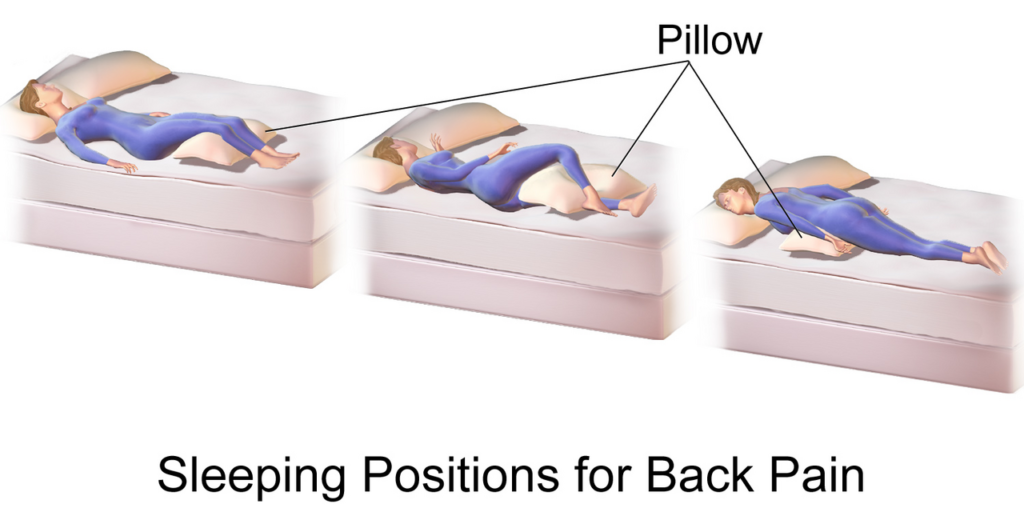
Both Cleveland Clinic pieces recommend side or back sleeping. The guidance is specific on how to make each position kinder to the spine. For back sleepers, lying with the legs flat can make the lower back arch too much, so a small pillow under the knees helps. For side sleepers, a pillow between the legs is the suggestion.
| Position | What the sources say | Adjustment they suggest |
|---|---|---|
| Stomach | Flattens and twists the spine’s curve; head turned to the side extends the neck | Practice switching; pillows as bumpers |
| Side | Harvard: most protective against back and neck pain | Pillow between the legs; pillow height that keeps the neck neutral |
| Back | Preferred by Cleveland Clinic over stomach | Small pillow under the knees |
Expect a few uncomfortable nights. Your body will drift back to the habitual position in your sleep, which is why the bumper pillows matter. A slow approach, where you start the night on your side and let the early hours do the habit-building, is a practical way to ease in. That is common-sense advice rather than a sourced protocol.
When pain is not just a sleeping position problem
If posture is the cause, changing positions should eventually help. If it does not, look beyond the bed. Cleveland Clinic’s neck pain page lists, for urgent care, pain after an accident, loss of bowel or bladder control, pain that persists when you move and when you are still, headache with dizziness, nausea or vomiting, chills or fever, unexplained weight loss, numbness or tingling in the arms, shoulders or legs, leg weakness or loss of coordination, no relief from over-the-counter medication, and no improvement after one week.
For the back, NIAMS says to see a provider if pain does not improve after a few weeks, if you have numbness and tingling, if severe pain is not improving with medication, after a fall or injury, or if back pain comes with trouble urinating, leg weakness, fever or unintended weight loss.
Our take
Stomach sleeping is the position the sources like least for neck and lower back, because it flattens the spine’s curve and keeps the head turned. Shift toward your side or back with pillows to support the change, and be patient: it takes practice. If your pain does not improve in a week or comes with numbness, weakness, fever or bladder or bowel changes, have it checked.
Common questions about stomach sleeping
Is stomach sleeping always bad for your back?
Cleveland Clinic says it is usually not recommended and Harvard ranks it worst for back and neck pain. Neither claims it harms every sleeper, but both point to the flattened spine curve and turned head.
What is the best position if I have neck pain?
Harvard says side lying is deemed the most protective against back and neck pain, and Cleveland Clinic prefers side or back sleeping. In either, pillow height matters: too low points the jaw up, too high aims it at the chest.
Can I train myself to stop sleeping on my stomach?
Cleveland Clinic says it takes a little practice and suggests pillows as bumpers to stop you rolling over.
How long before I should worry about neck pain?
Cleveland Clinic lists no improvement after one week among its reasons for urgent care. For back pain, NIAMS says a few weeks without improvement is a reason to see a provider.
From the Relief for Body desk
Every guide here is built from the manufacturer’s own documentation, published safety guidance, and the pattern in what owners report over months of use, not from a lab or a clinic. Nothing is sponsored, and verdicts are settled before any affiliate link goes in. We are not clinicians, and nothing on this site replaces one. How we review explains the process.
This article is general information, not medical advice. If pain is sharp, persistent, or getting worse, see a clinician.
Google lets you pick which sites come up first in your own results.