Relief for Body is reader-supported. When you buy through links on our site, we may earn an affiliate commission. This doesn't affect our verdicts.
No, a thicker anti-fatigue mat is not automatically a better one. The Canadian Centre for Occupational Health and Safety (CCOHS) says it plainly: “softer and thicker may not always be better.” Its advice is to pick a mat with some elasticity that is not so soft that you feel you cannot stand comfortably. A mat may not solve the entire problem, and one that is installed or shaped badly can itself be a tripping hazard. So the useful shopping question is how the mat feels under your feet and whether its edges are safe, not how many inches of foam it has.
This article is general information about standing gear, not medical advice. See our health disclaimer.
What a mat is actually for
CCOHS describes anti-fatigue mats as a way to reduce the fatigue that comes from standing on hard surfaces. The same page ranks concrete as the least comfortable surface to stand on, and says that wood, cork, carpet and rubber floors are more elastic. That ranking is useful at home. A kitchen with tile laid over concrete, or a garage workbench on a slab, is a harder place to stand than a room with a wood subfloor and a rug.
The page also sets the expectation: a mat may not solve the entire problem. It is one input. Shoes with arch and heel support and some cushioning count too, and so does moving around instead of holding one stance for hours. If you stand at a desk, the guidance in our standing desk converter comparison will help with the setup around the mat.
Why more cushion is not the goal
CCOHS advises a mat with some elasticity that is not so soft that you feel you cannot stand comfortably. It also warns that mats can cause trips if they are not installed properly. A deep, spongy mat with a square edge is something you can catch a toe on when you step off it, especially when you are carrying something.
The practical reading is that a mat should give a little and then resist. Press your heel into it. If it bottoms out immediately, it is too thin or too worn. If you sink and wobble, it is too soft. CCOHS gives no numeric thickness in this guidance, and we will not invent one. Any product page that claims an exact “ideal thickness” is offering its own opinion, not an occupational health standard.
Edges, grip and cleaning
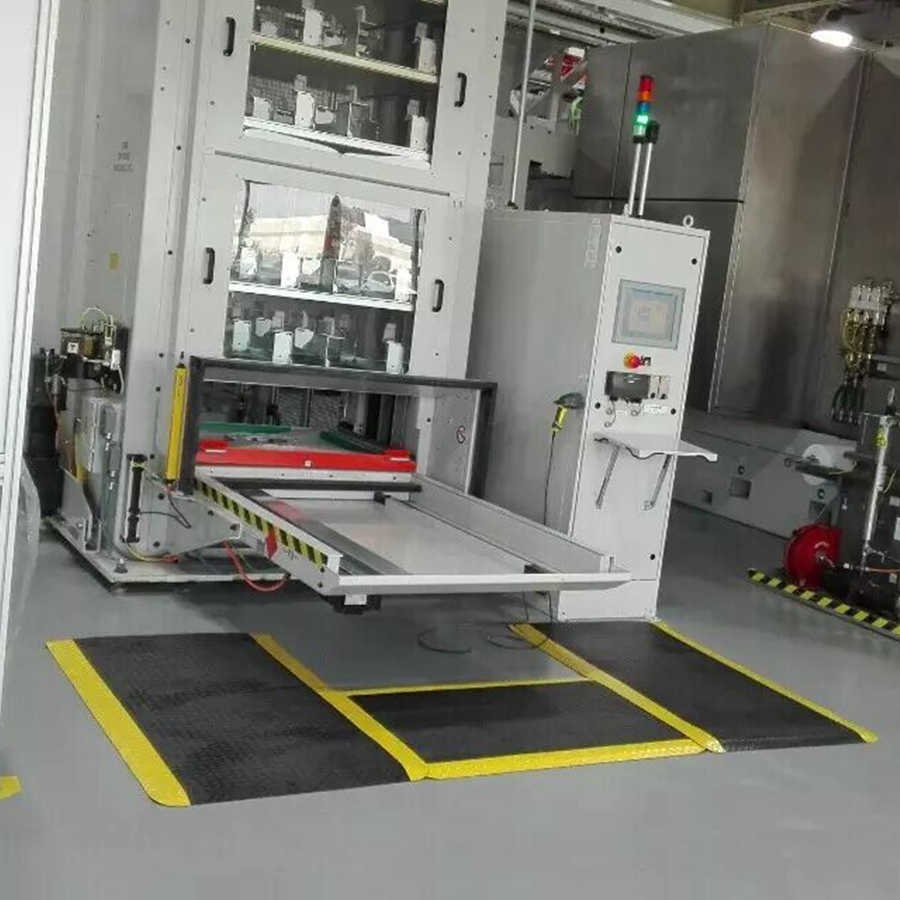
CCOHS says mats should have sloped edges and should not slip or create a trip hazard. That checklist matters more than the marketing label.
- Look for a beveled or tapered edge you can walk onto without catching a toe.
- Check that the bottom grips the floor. A mat that creeps across a smooth floor is a hazard whatever its cushioning.
Decide if you need anti-slip or anti-fatigue, too. CCOHS treats them as different purposes, and a product built for one does not necessarily do the other.
Cleanability depends on the room. CCOHS flags it for food preparation areas, and in a home kitchen the same logic applies. A surface that traps crumbs and grease is a poor fit next to a stove, and a material you can wipe down is easier to live with than one that needs scrubbing.
Where it makes sense to use one
Spots where you stand still in one place get the most from a mat: a kitchen sink or counter, a workbench, a standing desk, a laundry station. Places where you walk back and forth gain less, and a thick mat there mostly adds something to trip on. At a desk, a mat follows the same logic as a footrest. Our piece on do you need a footrest covers the seated side of the same problem.
Some people stand on a mat and still feel their feet and low back tire within the hour. That does not mean the mat failed. CCOHS notes in its guidance on working in a standing position that standing on a regular basis can cause sore feet, swelling of the legs and low back pain, and that changing between positions frequently is part of a well-designed setup. Alternating feet, shifting weight, and sitting for a while are all ordinary ways to change load. For timing, see how often to stand up from the desk, which applies in reverse: if you are standing all day, the break to look for is a sitting one.
Who should be careful
Anyone with balance problems or a history of falls should treat a soft mat as a trip risk first and a comfort item second. A firmer, thinner mat with a tapered edge is the safer pick in that situation. If you have foot pain that lasts, swelling in your legs, or pain that spreads or comes with numbness, a mat is not the next step. See a clinician. Our compression socks explainer covers one related product that also needs a medical conversation when symptoms are persistent.
| Feature | What CCOHS says | What to do about it |
|---|---|---|
| Thickness and softness | Softer and thicker may not always be better | Choose some elasticity without a sinking feel |
| Edges | Sloped edges, no trip hazard | Prefer tapered edges, replace curled ones |
| Grip | Must not slip | Test on your own floor before relying on it |
| Floor underneath | Concrete is the least comfortable surface | Expect a bigger benefit on hard slabs and tile |
| Footwear | Arch and heel support matter | Do not stand barefoot all day on any mat |
Cleaning and replacing a mat
A mat that curls at the corners, flattens in the places you stand, or leaves marks on the floor has done its job and should go. Wipe it with the cleaner the maker recommends, and check the underside occasionally, since dirt there can reduce grip. None of the sources we reviewed give a lifespan, so treat wear as the signal. Flat spots where your heels land mean the cushioning no longer pushes back, and a flat mat is only a rug with a trip edge.
Also lift the mat when you vacuum or mop. Moisture trapped under it can damage some floors and make the base slick.
Verdict
A mat is worth buying if you stand in one spot for long stretches on a hard floor. Pick moderate give, a tapered edge and a grippy base, and skip the pillowy ones. Judge it by how your feet feel after a long shift rather than by thickness figures on a product page. If the mat does not solve the problem, change how you stand and what you wear before buying another.
Common questions
How thick should an anti-fatigue mat be?
CCOHS gives no thickness figure. It says softer and thicker may not always be better and advises a mat with some elasticity that you can still stand on comfortably.
Can an anti-fatigue mat cause tripping?
Yes, if the mat is badly installed or shaped. CCOHS says mats can cause trips when they are not installed properly, and that they should have sloped edges and should not slip.
Do anti-fatigue mats cure sore feet?
No. CCOHS says a mat may not solve the entire problem. Footwear, floor type and how often you change position all contribute.
Sources
- Anti-fatigue mats, Canadian Centre for Occupational Health and Safety (CCOHS)
- Working in a standing position: basic information, Canadian Centre for Occupational Health and Safety (CCOHS)
From the Relief for Body desk
Every guide here is built from the manufacturer’s own documentation, published safety guidance, and the pattern in what owners report over months of use, not from a lab or a clinic. Nothing is sponsored, and verdicts are settled before any affiliate link goes in. We are not clinicians, and nothing on this site replaces one. How we review explains the process.
This article is general information, not medical advice. If pain is sharp, persistent, or getting worse, see a clinician.
Google lets you pick which sites come up first in your own results.