Relief for Body is reader-supported. When you buy through links on our site, we may earn an affiliate commission. This doesn't affect our verdicts.
A chin tuck is a small, level movement: you draw your head straight back over your shoulders without tilting it up or down, hold for a few seconds, and release. Done gently and often, it is a low-risk way to move a neck that has been parked forward for hours. What it is not is a proven fix for forward head posture. The sources below support the movement as sensible advice and show some early signs of benefit, but none of them is a large controlled trial.
What a chin tuck is, and what it is not
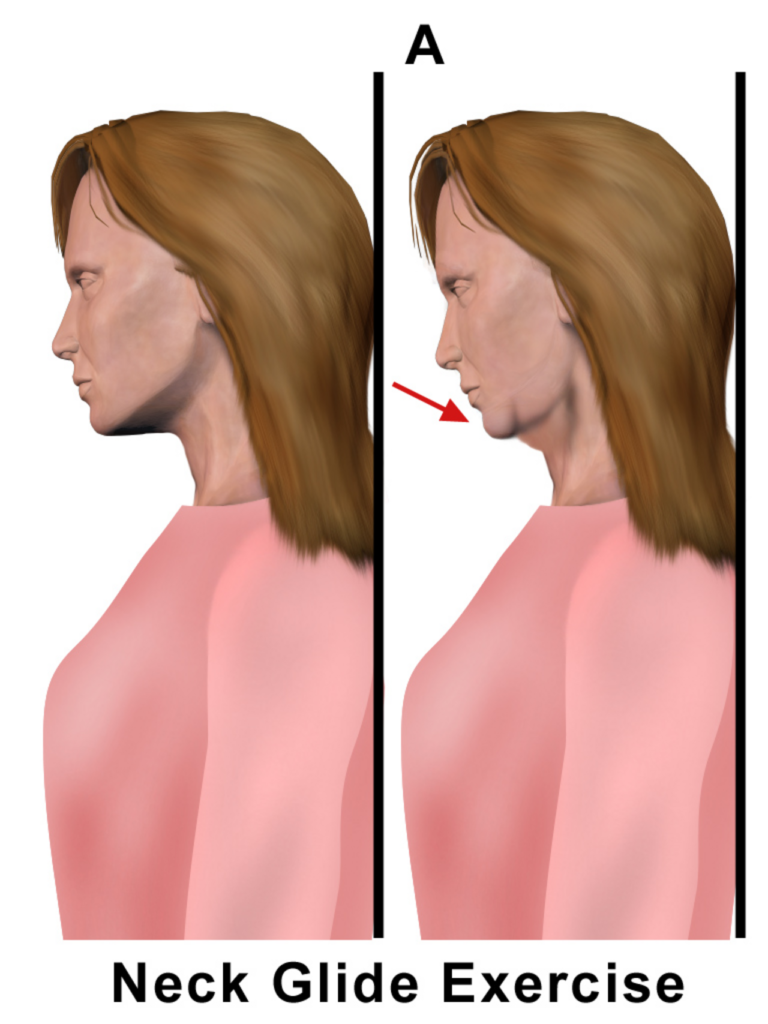
Most people picture a chin tuck as nodding the head down toward the chest. That is not what Cleveland Clinic describes. In its list of posture exercises, the move is called pulling your head back. While sitting, you pull your chin backward without changing the level of your eyes, meaning you do not look up or down. The fingertips can gently help coax the chin back, and you hold the position for several seconds.
The picture to keep in mind is a turtle pulling its head into its shell, flat and straight, not a nod. If you feel the back of the neck stretch slightly and see your gaze stay on the same spot across the room, the movement is close to right.
Harvard Health describes a version that includes a nod. In its neck pain prevention guide, the instruction is to gently tuck your chin toward your chest and hold for 10 seconds, then gently extend your neck to look upward for 10 seconds, and repeat five times. So two reputable sources describe two slightly different movements under similar names. The Cleveland version is a horizontal glide. The Harvard version is a tuck followed by a look-up. If you are unsure which to use, the gentler and more controlled one is the better starting point, and a physical therapist can pick for you.
A wall check for your starting position
Cleveland Clinic offers a simple test. Stand with your back against a wall, fix your eyes on a spot at comfortable eye level, and pull your head back until it touches the wall. If your head is far from the wall in your natural stance, or if you can only reach it by tilting your chin up, your usual head position sits forward of where it ends up in the exercise.
This check is a self-test, not a measurement. The page does not give a distance that counts as normal or a number that counts as a problem, so avoid reading too much into the gap. Its use is as a reference position to practice from, and as a way to notice if you are tilting rather than gliding.
How to practice it
None of the pages gives a rep count for Cleveland Clinic’s version, so there is no sourced prescription to quote. What the sources do give is a pattern you can follow without overthinking it:
- Sit or stand tall with your eyes level and your jaw relaxed.
- Glide the head straight backward, using fingertips lightly if that helps.
- Hold for several seconds, then release and breathe.
- Stay within a comfortable range. Harvard’s wording is “gently” throughout.
Pain is the signal to stop and reassess. A stretch along the back of the neck is expected. Sharp pain, tingling or anything that spreads into the arm is not.
What the one clinical study actually showed
A 2020 paper in Annals of Rehabilitation Medicine is the closest thing to a clinical result among these sources. It is a retrospective analysis of 47 patients who had neck pain and a loss of the normal forward curve of the neck. The program pushed the chin backward while raising the head within a pain-free range for 3 seconds, then pulled the shoulders back and extended the neck within a pain-free range for 10 seconds. Patients did it at least 10 times daily for 6 to 8 weeks.
Pain on a numeric rating scale fell from an average of 6.04 to 3.06, a statistically significant change (p below 0.001). The authors noted no serious side effects in the reviewed medical records.
Read that result with its limits in view. The study looked back at existing records, it had no comparison group, and it measured a patient population with a specific diagnosis. People tend to improve over weeks on their own, and a before-and-after drop in pain cannot separate the exercise from time passing. The study shows the routine was tolerated and was followed by improvement. It does not show that the chin tuck caused the improvement.
| Source | What it supports | What it does not show |
|---|---|---|
| Cleveland Clinic, posture exercises | A seated head pull-back with level eyes; a wall check | Reps, frequency or a normal head distance |
| Harvard Health | A gentle tuck-and-look-up, 10 seconds each, five times | That it corrects posture |
| 2020 retrospective study, 47 patients | Lower pain scores after 6 to 8 weeks of daily practice | Cause and effect; no control group |
Why the desk matters more than the exercise
A set of tucks does little if you spend the remaining hours with the head thrust toward a low screen. Cleveland Clinic’s neck pain page lists straining the neck to view a computer screen for long periods as a common cause of neck pain, and suggests arranging devices so you do not slouch or strain. Raising the display is the larger lever, and the post on monitor height walks through it. If you are wondering about devices that pull your shoulders back, the posture corrector guide covers what they can and cannot do.
Think of the chin tuck as a break from the forward position, not a repair of it. Used a few times between tasks, it gives the neck a different position to rest in. That is a modest claim, and the sources support it at that level.
When to see someone instead
Cleveland Clinic says to see a healthcare provider, such as a primary care doctor or physical therapist, if the exercises are not helping. Harvard says to see a doctor for persistent or severe pain, or for numbness, tingling or weakness in the neck, shoulders or arms, and to seek immediate attention if neck pain comes with fever, unexplained weight loss or difficulty moving.
Cleveland Clinic’s neck pain page adds pain after an accident, loss of bowel or bladder control, headache with dizziness, nausea or vomiting, numbness or tingling in the arms, shoulders or legs, leg weakness or loss of coordination, and pain that has not improved after one week. Any of those means skipping the home routine and getting evaluated.
Our take
A chin tuck is a reasonable, low-effort movement break for a neck held forward at a screen, and two major health sources describe it. The evidence that it corrects posture is thin: one small retrospective study with no control group. Do it gently, stay within a pain-free range, and fix the screen height first. Stop and see a clinician for numbness, weakness, fever or pain that does not improve.
Common questions about chin tucks
How many chin tucks should I do a day?
The Cleveland Clinic page gives no repetition count. Harvard’s version is five repetitions of a 10-second hold each way. The 2020 study used a program of at least 10 times daily, but it was a small retrospective review, so treat that as an example rather than a target.
Should my chin go down or straight back?
Cleveland Clinic describes pulling the chin straight back with the eyes staying level. Harvard describes tucking the chin toward the chest and then looking up. Both say to be gentle. If one version hurts, try the other or ask a physical therapist.
Can chin tucks cure forward head posture?
No source cited here says so. The best available result is a small before-and-after study showing lower pain scores, with no comparison group.
Is it normal to feel a stretch or pressure?
A mild stretch at the back of the neck fits the movement. Sharp pain, tingling or numbness does not, and Harvard lists numbness, tingling or weakness in the neck, shoulders or arms as a reason to see a doctor.
From the Relief for Body desk
Every guide here is built from the manufacturer’s own documentation, published safety guidance, and the pattern in what owners report over months of use, not from a lab or a clinic. Nothing is sponsored, and verdicts are settled before any affiliate link goes in. We are not clinicians, and nothing on this site replaces one. How we review explains the process.
This article is general information, not medical advice. If pain is sharp, persistent, or getting worse, see a clinician.
Google lets you pick which sites come up first in your own results.