Relief for Body is reader-supported. When you buy through links on our site, we may earn an affiliate commission. This doesn't affect our verdicts.
“Text neck” is a popular name, not a diagnosis, for neck and upper back soreness that people connect with long stretches of looking down at a phone. Is it real? Bending your head forward does put more load through the neck, and plenty of people feel sore after a long scroll. But the best recent long-term data did not find that phone-flexion angle predicts who ends up with neck pain. Both things can be true, and the practical advice is the same either way.
What “text neck” actually describes
Cleveland Clinic uses the term “tech neck” for strain from spending a lot of time with the head tipped forward over a phone, tablet or laptop. Its overview lists the usual complaints: stiffness or soreness, sharp pain in the neck and shoulders, headaches, and in some people numbness or tingling in the arms, hands and fingers. Nothing on that list is unique to phones. A person who hunches over a laptop or a sewing machine can describe the same symptoms, which is one reason the label gets criticized.
Cleveland Clinic’s separate page on neck pain makes the same point from the other direction. It says that straining your neck to view a computer screen for long periods is a common cause of neck pain, and it advises positioning electronic devices so you do not have to slouch or strain your neck. The mechanism is sustained awkward posture. The phone is just the most portable way to get into it.
How much extra load does a forward head put on the neck?
This is where the most-quoted numbers come from. According to Cleveland Clinic, a head in a neutral position weighs about 10 to 12 pounds. A slight downward glance is equivalent to about 27 pounds on the neck, a 30-degree tilt to about 40 pounds, and a significant forward bend to roughly 60 pounds or more.
Two cautions before repeating those figures. First, the page presents them without citing a study, so treat them as a clinic’s illustration of the principle rather than a measured result you can apply to your own spine. Second, the underlying idea is simple mechanics: the farther the head sits in front of the shoulders, the more work the muscles at the back of the neck do to hold it up. The direction of the effect is not in dispute. The exact pounds are less certain.
Harvard Health says something similar in plainer words. In its guide to preventing neck pain, it notes that even a slight forward tilt can dramatically increase the load on your neck.
What a 2025 long-term study found
If forward flexion were the main driver of neck pain, people who flex their necks more while texting should report more pain over time. A 12-month study in the Brazilian Journal of Physical Therapy tested exactly that. The paper enrolled 457 participants, and 396 (87 percent) completed follow-up. Cervical flexion was measured with a range-of-motion device while participants texted standing and sitting.
The authors reported that cervical flexion posture during smartphone use was not a risk factor for neck pain or for how often it occurred. The odds ratios sit almost exactly at 1: 1.01 for standing (confidence interval 0.97 to 1.04) and 1.01 for sitting (0.98 to 1.04). What did predict neck pain was low sleep quality (odds ratio 1.76) and insufficient physical activity (odds ratio 2.41).
That result has limits, and the paper says so. The average age was about 27, the study ran through the COVID period, and neck pain was assessed with a single question. It does not prove that phone posture never matters, and it does not apply neatly to a 55-year-old with an existing neck problem. What it does suggest is that the angle of your neck during a single texting session is a weaker predictor than the broader picture: how well you sleep and how much you move.
What the physiotherapy literature can and cannot tell you
A 2025 scoping review in the Journal of Clinical Medicine looked at physiotherapy for text neck syndrome. Its authors concluded that the included studies suggest physiotherapeutic interventions can help, and in the same breath that further high-quality research is needed. The review lists why: lack of blinding, young adult participants, small samples, short duration and no long-term follow-up. About 60 percent of the studies came from India, which may limit how well the findings carry over to other populations.
So the evidence for specific exercise programs is early. That is not a reason to skip movement. It is a reason to be skeptical of any product or routine that promises to “reverse” text neck.
What to change, in order of effort
The advice that shows up across the sources is modest and cheap. Raise the device toward eye level instead of lowering your head to it. Cleveland Clinic’s advice is to bring the screen up and use a stand at eye level when you can. Harvard adds that you should not cradle a phone between your ear and shoulder. For laptops and monitors the same logic applies, and the post on monitor height covers the desk side.
The second change is to stop holding any one position for long. Cleveland Clinic’s line is that the best posture is a moving posture, and it suggests limiting sessions to about 15 to 30 minutes at a stretch. Setting a timer is clumsy, but it beats good intentions.
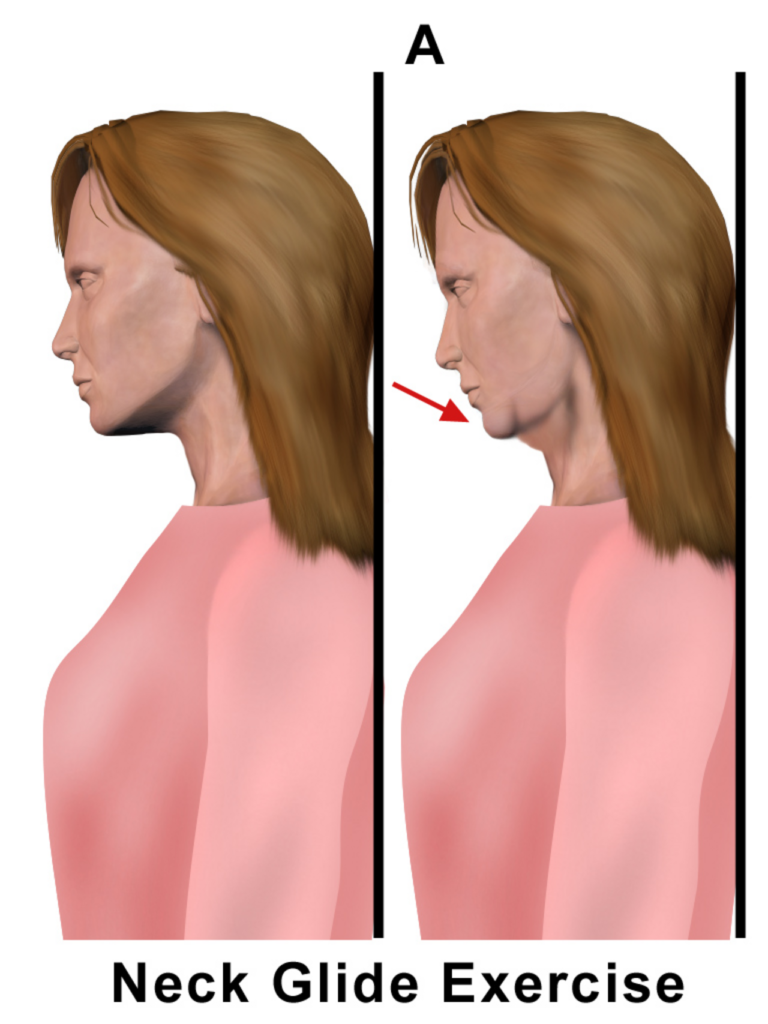
Third, a gentle chin tuck is the exercise Harvard describes for neck pain prevention: gently tuck your chin toward your chest and hold for 10 seconds, then gently extend your neck to look upward for 10 seconds, and repeat five times. Heat or cold on a sore neck and short-term over-the-counter pain relievers are the other self-care steps Cleveland Clinic mentions.
Gadgets that promise to pull your shoulders back are a different matter. The question of whether posture correctors work gets a more cautious answer than the marketing gives.
| Habit | What the sources say |
|---|---|
| Device held low | Raises neck load; Cleveland Clinic and Harvard both advise bringing it up toward eye level |
| Long unbroken sessions | Cleveland Clinic suggests limiting to about 15 to 30 minutes and moving in between |
| Phone cradled at the shoulder | Harvard says to avoid it |
| Poor sleep, low activity | Linked to neck pain in the 2025 follow-up study, more strongly than phone flexion |
When to stop self-treating and call someone
Neck soreness from posture usually eases when you change the posture. Some symptoms point somewhere else. Harvard says to see a doctor for persistent or severe pain, or for numbness, tingling or weakness in the neck, shoulders or arms. It says to seek immediate attention if neck pain comes with fever, unexplained weight loss or difficulty moving.
Cleveland Clinic’s neck pain page gives a longer list for urgent care: pain that follows an accident, loss of bowel or bladder control, pain that persists when you move and when you stay still, headache with dizziness, nausea or vomiting, chills or fever, numbness or tingling in the arms, shoulders or legs, leg weakness or loss of coordination, pain that does not respond to over-the-counter medication, or pain that has not improved after one week. A sore neck after a long phone session fits none of those. A sore neck plus any of them deserves a clinician, not a stretching video.
Our take
Treat text neck as a posture and movement problem, not a diagnosis. The load figures are a useful illustration but come without a cited study, and the best 2025 follow-up data found phone flexion angle did not predict neck pain, while poor sleep and low activity did. Raise the screen, break up long sessions, and get checked if you have numbness, weakness, fever or pain that does not improve.
Common questions about text neck
Is text neck a real medical condition?
It is a popular label rather than a formal diagnosis. The symptoms it describes, such as neck stiffness, shoulder pain and headaches, are real and common, and Cleveland Clinic links them to long periods with the head tipped forward.
Does looking at your phone cause permanent damage?
None of the sources cited here say that. Cleveland Clinic describes the problem as strain and soreness, and the 2025 long-term study did not find phone flexion to be a risk factor for neck pain. If symptoms last or include numbness or weakness, see a doctor.
How long can I look at my phone before taking a break?
Cleveland Clinic suggests limiting sessions to about 15 to 30 minutes and changing position in between. No source cited here gives a threshold proven to prevent pain.
Do neck exercises fix it?
A scoping review found that physiotherapy interventions seem to help, but its authors say better-designed studies are needed. Gentle movement such as the chin tuck Harvard describes is low risk for most people, but stop if it increases pain.
From the Relief for Body desk
Every guide here is built from the manufacturer’s own documentation, published safety guidance, and the pattern in what owners report over months of use, not from a lab or a clinic. Nothing is sponsored, and verdicts are settled before any affiliate link goes in. We are not clinicians, and nothing on this site replaces one. How we review explains the process.
This article is general information, not medical advice. If pain is sharp, persistent, or getting worse, see a clinician.
Google lets you pick which sites come up first in your own results.