Relief for Body is reader-supported. When you buy through links on our site, we may earn an affiliate commission. This doesn't affect our verdicts.
Manufacturer manuals for percussion massagers are unusually consistent on one point: keep the device off the front of the neck entirely. That’s not a comfort suggestion. The front of the neck sits over the carotid arteries, the jugular veins, and the thyroid, and general guidance from device makers treats that whole zone as off-limits, not just an area to be gentle with. The sides and back of the neck get different, more permissive guidance, which is where most of the confusion starts.
This article describes what manufacturer instructions and general product guidance say. It isn’t a medical recommendation for your specific neck, and anyone with an existing neck injury, a clotting disorder, or ongoing neck pain should talk to a clinician before using any percussion device there at all.
What part of the neck do manuals say to avoid?
The front and the sides closest to the throat are the areas named most often. Behind that is the spine itself, running up into the base of the skull, which manuals treat separately from muscle tissue. The trapezius, the thick muscle running from the base of the skull out to the shoulder, is generally treated as fair game at low speed, since it’s a large muscle rather than a narrow, vessel-dense area.
| Neck area | Typical manufacturer guidance |
|---|---|
| Front of neck (throat, carotid area) | Avoid entirely |
| Directly over the spine or vertebrae | Avoid entirely |
| Base of the skull | Avoid or use only the lightest setting, briefly |
| Sides of the neck, away from the throat | Low speed, short duration, cushioned head |
| Upper trapezius (base of neck into shoulder) | Generally permitted at low to moderate speed |
Why the front of the neck specifically?
The concern isn’t muscle soreness. It’s the concentration of blood vessels sitting close to the surface in that area, along with the thyroid gland. Applying repeated percussive force directly over the carotid artery is flagged in general product safety guidance as a risk for reduced blood flow to the brain, in rare cases, which is a different order of concern than a bruised muscle.
This is also why massage therapists working professionally around the neck are trained specifically in that anatomy, something a set of written instructions in a product box can’t replace. Anyone whose neck tension traces back to a desk setup might get more mileage from fixing the setup itself, covered in the ergonomic desk setup guide, than from a device pointed at the symptom.
The concern also scales with pressure and speed. A light touch near the throat carries less risk than a firm one, but general product guidance doesn’t tend to draw a line at “gentle enough” and call the front of the neck safe. The recommendation is almost always to avoid the area outright rather than to modify the approach and stay there.
Does device size or power change any of this?
Not in a way that loosens the guidance. A smaller, lower-power handheld device isn’t treated as safer for the front of the neck just because it hits less hard than a full-size one. The anatomy underneath doesn’t change based on the device pointed at it, so the same areas stay off-limits regardless of which model someone owns. Where power does matter is at the trapezius and other permitted areas, where a gentler device gives more room for error if someone new to percussion tools presses a bit too hard.
Is the back of the neck treated differently?
Yes, but not without its own limits. The muscle beside the spine can generally take a light session with a fork-style attachment, since that shape is built to straddle the bony ridge rather than press on it. Directly over the spine, including each individual vertebra, is a different story. Manuals are consistent that the spine itself should never take a direct hit from any attachment, on the neck or anywhere else along the back.
What do manuals say about session length at the neck?
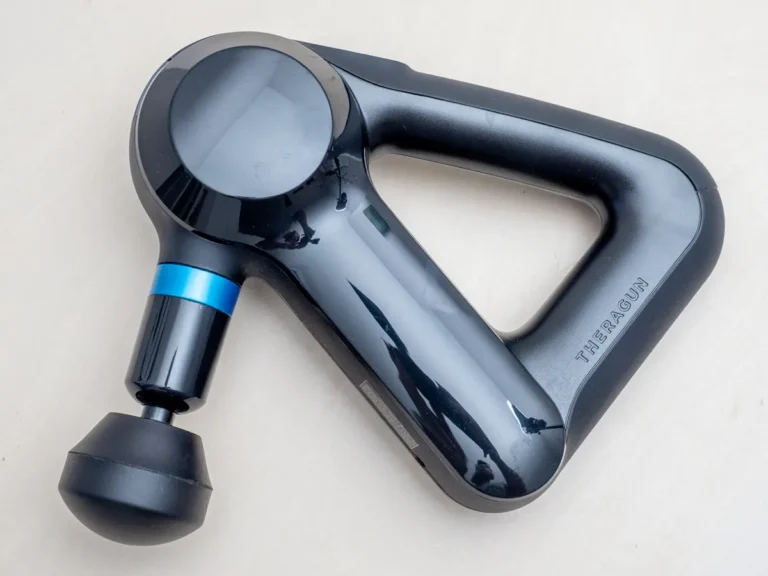
Where a large muscle like the quad might reasonably take up to two minutes, guidance for the neck area generally shrinks that down, often to somewhere between 10 and 30 seconds per pass, at the lowest available speed setting. A cushioned attachment rather than a pointed one is the standard recommendation for this area, precisely because there’s less muscle mass to absorb a sharper strike. For more on how attachment choice changes the impact, the buying guide covers what to look for when choosing a device in the first place.
Who should skip the neck area entirely, per manufacturer guidance?
Pregnant people, anyone with a blood clotting disorder, anyone on blood thinners, and anyone with an existing neck injury, recent neck surgery, or a diagnosed spinal condition are named across various manufacturer disclaimers as groups who should avoid the neck with these devices, or skip percussion tools there altogether. This list isn’t exhaustive and it isn’t a substitute for a conversation with a clinician about a specific health situation.
A general rule that shows up often in owner guides: if you’re asking whether it’s safe for your neck, that’s usually the moment to ask a professional rather than a product manual. Heat is the other option that comes up often for neck tension specifically, and the difference between the two approaches is laid out in the heat versus cold guide.
What do owners say happens when they ignore the warning?
The complaint pattern that shows up most in reviews and forum posts isn’t dramatic. It’s soreness, a feeling of pressure or headache after using a device too close to the base of the skull, or lightheadedness after running it over the front of the neck for even a short time. People who report the mildest experiences tend to describe sticking to the trapezius and avoiding the throat and spine entirely, which lines up with the manufacturer guidance above.
None of this is unique to expensive devices. Budget and premium percussion massagers carry nearly identical neck warnings in their manuals, since the anatomy being avoided doesn’t change with price. A cheaper device with fewer speed settings doesn’t get a pass here either, since the risk comes from location rather than power output alone. A broader look at how devices compare on other fronts, including noise, sits in the quieter massage gun roundup.
Verdict
The trapezius, low speed, short passes: that’s the part of the neck manufacturers generally allow. The front of the throat and the spine itself are consistently flagged as off-limits, and ongoing neck pain is a reason to see a clinician rather than reach for a device.
Frequently asked questions
Can you use a massage gun on the back of your neck?
The trapezius muscle at the base of the neck is generally treated as usable at low speed and short duration in manufacturer guidance, while the spine running up the back of the neck is treated as off-limits for direct contact. A cushioned attachment rather than a pointed one is the common recommendation for this area.
Why do massage guns warn against the neck?
The front and sides of the neck sit close to major blood vessels and the thyroid gland, which is why manufacturer instructions single out that area for stricter limits than muscles elsewhere on the body. The spine running through the neck is a separate concern, since manuals warn against direct contact with any vertebra.
Is it safe to use a massage gun on a stiff neck?
General guidance allows brief, low-speed use on the trapezius muscle for ordinary stiffness, but persistent neck pain, pain that spreads down an arm, or pain following an injury is generally treated as a reason to see a clinician rather than a percussion device. Manuals frame these tools as comfort aids, not treatment for an underlying problem.
What attachment is safest for the neck?
A soft, cushioned head at the lowest speed setting is the pattern most manufacturer guides recommend for the neck, when the trapezius muscle is the target. Pointed or bullet attachments concentrate force into a smaller area and are generally discouraged for this part of the body.
If a neck issue keeps coming back regardless of what device or attachment gets used, that’s a pattern worth mentioning to a physical therapist rather than solving with a different tool. A device isn’t diagnostic, and repeated tension in the same spot is information worth handing to someone who can actually examine it.
From the Relief for Body desk
Every guide here is built from the manufacturer’s own documentation, published safety guidance, and the pattern in what owners report over months of use, not from a lab or a clinic. Nothing is sponsored, and verdicts are settled before any affiliate link goes in. We are not clinicians, and nothing on this site replaces one. How we review explains the process.
This article is general information, not medical advice. If pain is sharp, persistent, or getting worse, see a clinician.
Google lets you pick which sites come up first in your own results.