Relief for Body is reader-supported. When you buy through links on our site, we may earn an affiliate commission. This doesn't affect our verdicts.
A TENS unit sends a mild electrical current through pads on the skin. A massage gun taps the tissue mechanically, hundreds of times a minute. They feel completely different, they suit different moments, and the choice is simpler than the marketing makes it: the gun is for muscles that feel tight after use, the TENS unit is for sitting still while something buzzes.
Neither one treats anything. Both are comfort tools, and the honest way to pick is by when you would actually reach for it.
What each one does
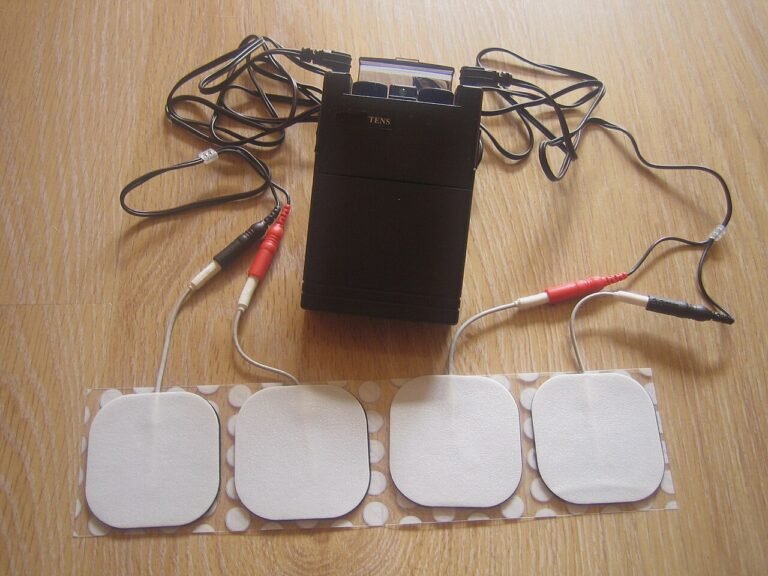
A TENS unit runs a low-voltage current between two or four adhesive pads. What you feel is a tingle or a light tapping sensation that you can dial up or down. Sessions typically run fifteen to thirty minutes, you stay seated or lying down, and the unit is small enough to clip to a waistband.
A massage gun drives a head into the tissue at an adjustable speed and stroke depth. It is loud, it is handheld, and it works in a couple of minutes per area. You move it along a muscle rather than parking it in one spot.
The practical difference is what you can do while using each. A TENS unit runs in the background while you work at a desk or watch something. A massage gun demands both your attention and one hand, which is why it rarely gets used on the muscles behind your own shoulder blade.
| Feature | TENS unit | Massage gun |
|---|---|---|
| Sensation | Tingling or pulsing | Percussive tapping |
| Session length | 15–30 minutes | 1–2 minutes per area |
| Hands free | Yes | No |
| Reaches your own back | Yes, with pads | Awkwardly, with an extension |
| Noise | Silent | Noticeable |
| Typical cost | $25–$80 | $50–$300 |
| Consumables | Replacement pads | None |
When each one makes sense
Reach for the gun after activity, when a muscle group feels tight and worked and you want two minutes on the quads or calves before a shower. It is also the more useful tool for warming up, because it wakes tissue quickly.
Reach for the TENS unit during long stretches of sitting still, or in the evening when you want something running on a stiff lower back while your hands are busy. It is also the option that works on areas you cannot reach yourself, since pads go on and stay there.
Plenty of people end up owning both, and they rarely compete for the same moment.
Devices worth a look
Neocarbon TENS Unit Muscle Stimulator
A dual-channel unit that runs four pads at once, with both TENS and muscle-stimulation modes.
- Four pads cover a broad area such as a lower back in one session
- Preset programs and a timer, so there is nothing to configure each time
- Pads wear out with use, though the kit ships with 16 reusable ones in three sizes
Omron Pocket TENS Unit
A simple, compact unit for people who want three buttons rather than a menu.
- Small enough to clip on and forget during a session
- Straightforward controls with preset intensity levels
- Single channel, so it covers a smaller area than a four-pad unit
Renpho Massage Gun
The budget percussion pick, and enough gun for anyone who is not using it daily.
- Several speed settings and interchangeable heads for different areas
- Battery lasts through multiple sessions between charges
- Louder and shallower-stroking than premium models
Verdict
Buy the massage gun if the pattern is tight muscles after training or a long walk. Buy the TENS unit if the pattern is a stiff lower back through a working day and you want something that runs hands-free. If you are choosing on price alone, an entry-level TENS unit costs less than an entry-level gun and needs no technique.
Safety, briefly and seriously
TENS units carry real contraindications, and they are not optional reading. Do not use one if you have a pacemaker or any implanted electrical device, during pregnancy without clearance, over the front or sides of the neck, across the chest, over broken or irritated skin, or over areas where sensation is reduced. If you have epilepsy or a heart condition, ask a clinician before starting.
Massage guns have a shorter list but it still matters: keep them off bone, off the head and neck, away from any area that is bruised, swollen or recently injured, and away from varicose veins. If you are on blood thinners or have a clotting condition, check first.
For either device, discomfort that keeps returning, spreads, or comes with numbness, weakness or tingling into a limb is a reason to see a clinician rather than to buy a stronger device.
Which of those two applies to what you are feeling right now is its own question, and our heat or cold tool answers it in four steps.
Where these sit next to heat and cold
A heating pad is often the cheaper first move for a stiff back at a desk, and it needs no technique at all; our page on heating pads for desk-related back discomfort covers that, and heat versus cold covers which to reach for when.
If you are leaning toward percussion, our massage gun buying guide covers stroke depth and stall force, the roundup of quieter models matters more than people expect in a shared room, and the gun against a foam roller is the other comparison worth reading before ordering.
Pad placement, in plain terms
Most disappointment with a TENS unit comes from pad position rather than from the unit. Pads work as a pair, and the current runs between them, so the area you want covered has to sit in that path. Placing both pads an inch apart concentrates everything in a small patch; placing them too far apart spreads the sensation thin.
For a lower back, the usual arrangement is two pads either side of the spine at the level of the discomfort, roughly two to three inches apart, never directly on the spine itself. For a shoulder or a calf, one pad above the area and one below it puts the current through the middle. Four-pad units let you bracket a wider area, which is the main reason to buy one.
Start the intensity low and raise it until the sensation is strong but comfortable, then leave it. Skin adapts during a session and the tingle fades; that is normal, and chasing it upward is how people end up sore afterward.
Frequently asked questions
Can I use a TENS unit and a massage gun in the same session?
Yes, and people commonly use the gun first on a muscle group and the TENS unit afterward while sitting. Do not run both on the same spot at once, and never use a massage gun over TENS pads still attached to the skin. Keep total time on any one area modest.
How long do TENS pads last?
Usually somewhere between ten and thirty applications, depending on skin oils and how carefully you store them. Return them to the plastic backing after each use and keep them somewhere cool. When a pad stops sticking evenly it also stops conducting evenly, which is when it needs replacing.
Which is better for a stiff lower back after sitting?
Most people find the TENS unit easier for that pattern, simply because pads reach the lower back and stay put while a handheld gun is awkward to angle behind you. Neither addresses the cause, though. Chair height, monitor height and standing up more often do more than either device.
Are cheap TENS units on Amazon safe?
Look for one cleared by the FDA and sold by an established brand, and read the contraindication list before the first session. Cheap units often differ mainly in build quality and pad quality rather than in output. Skip anything with no manufacturer information, no clearance claim and no printed safety guidance.
Pick by moment rather than by feature list. If your hands are busy and you are sitting still, that is the TENS unit; if you have just finished moving and something feels tight, that is the gun.
From the Relief for Body desk
Every guide here is built from the manufacturer’s own documentation, published safety guidance, and the pattern in what owners report over months of use, not from a lab or a clinic. Nothing is sponsored, and verdicts are settled before any affiliate link goes in. We are not clinicians, and nothing on this site replaces one. How we review explains the process.
This article is general information, not medical advice. If pain is sharp, persistent, or getting worse, see a clinician.
Google lets you pick which sites come up first in your own results.